
Bio
R. Armstrong is a trans-disciplinary artist and writer exploring embodiment, decay, and wonder through language, sound, images, objects, and installation. Armstrong earned a BA with Honors in Sculpture from Yale, as well as an MFA in Poetry and an MA in English Literature from Bennington and Middlebury respectively. The artist has been awarded residencies at the Lower Manhattan Cultural Council and Akademie Schloss Solitude, which supported the creation of Wakes and Waking Sings, and was a WritingLive Fellow at Performa09. Work has been shown in the UK, Germany, Belgium, and the States, including the solo shows if you have a body when you get here at The Ocean/The Waves Gallery in New York and But Once We Dreamed and Du/e Corps/e nella Groundless Ground in Pennsylvania. Phrasebook for the Unrequited Country, a poetry manuscript, was shortlisted for the Walt Whitman Award from the Academy of American Poets and the Hawley Award from Alice James Books.
YardWork brought contemporary art and artists to the small community in the coal regions of northern Appalachia where the artist grew up. The project of linking the artist’s birthplace and current global community continues with Spinster Sister, a resource-share and gallery that opened in 2019 in central Pennsylvania, where the artist is currently based.
Statement
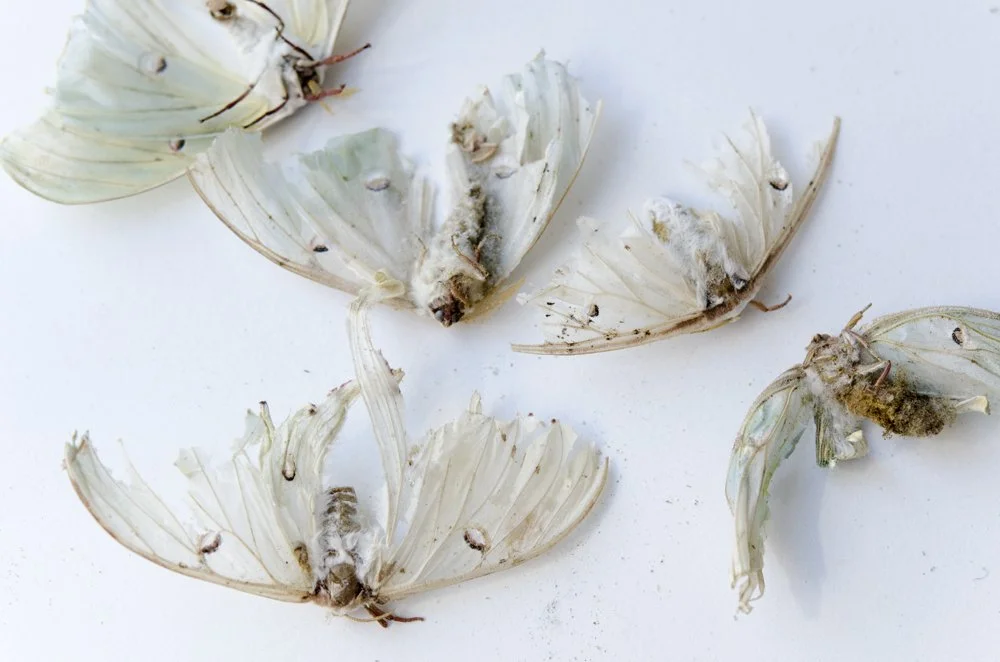
I use everything at hand– natural materials, sound, language, image-making, built structures– to create opportunities for humans to feel what we often avoid, including grief, awe, and complexity. Much of my work centers around embodiment because the body cannot avoid its griefs: we ache, we fracture, we de- and re- form. Sound creates a layer of meaning that enters the body directly, and holds all other elements in its unifying force. Using an often spare aesthetic and materials that have rich historical significance allows me to address climate, colonization, and violence through materiality. Live moths, dead foxes, bone china, marble, historical texts, bone, gold, and the sounds of extinct animals are a few examples of materials that layer historical significance into the work. Natural processes of decay and transformation are made visible, creating opportunities to confront loss and mortality in our long moment of crisis.